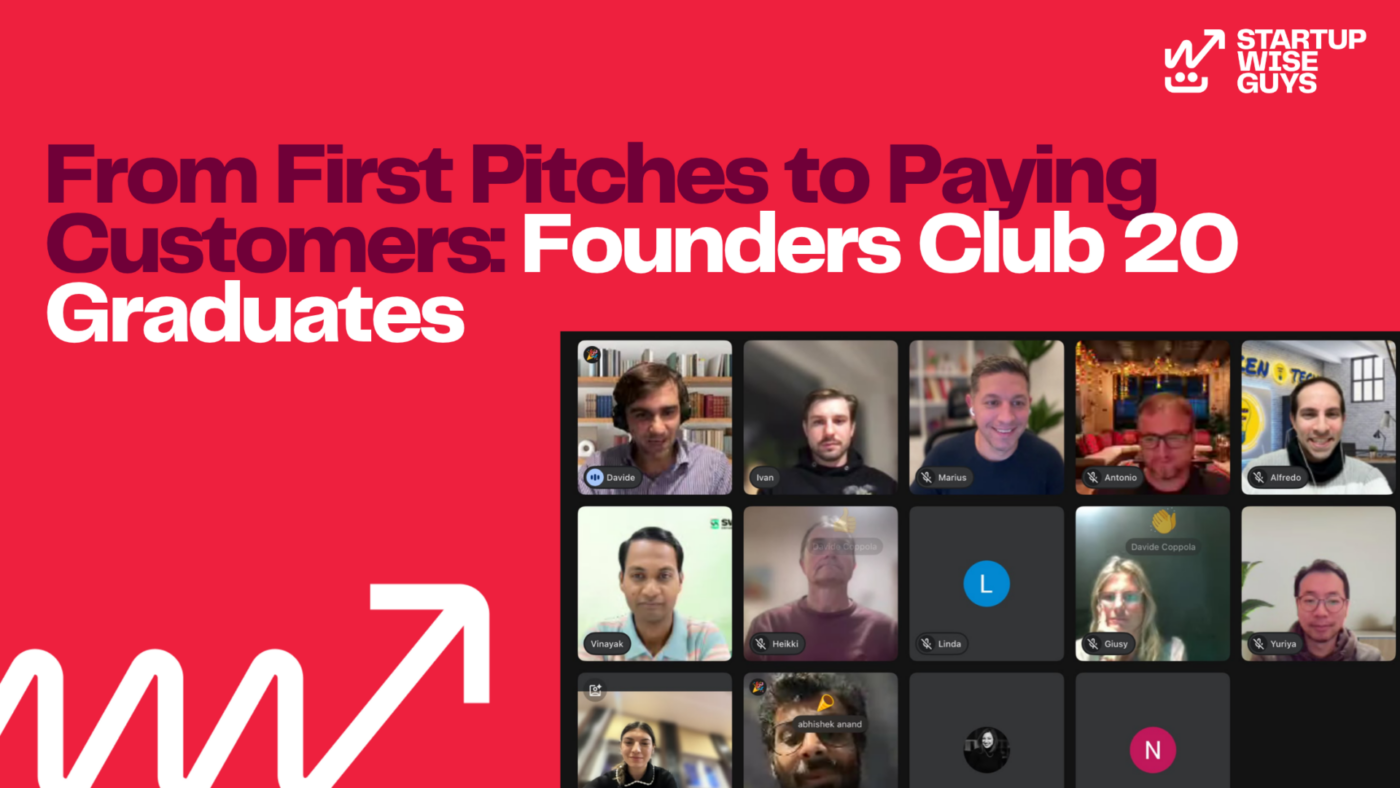
On November 5, five teams took the virtual stage for the Founders Club 20 Graduation Day. Three minutes to pitch, three minutes of questions, and three months of building squeezed into a few slides. Easy, right?
I’ve been running Founders Club for several cohorts now, and every group develops its own personality. FC20 started in the middle of summer, with founders spread across different countries, jobs, time zones and starting points.
Week after week, the energy picked up. By graduation, five teams were presenting businesses with customers, pilots, design partners, prototypes and, most importantly, a much clearer idea of what they need to prove next.
That’s the kind of momentum we look for in Founders Club by Startup Wise Guys.
Three months of venture building
Founders Club sits very early in the startup journey. Some founders join with a team and a product already in the market. Others arrive with an idea, a problem they know well, or simply the ambition to build something of their own.
Over three months, we put those starting points under pressure. Founders work on customer discovery, value proposition, business model, MVP, go-to-market and pitching, supported by mentors, regular check-ins and 1:1 conversations.
A big part of my job is asking questions that are occasionally annoying but usually useful: Who exactly has this problem? How many customers did you speak with? What did they actually say? Who is paying? Why now? What changed since last week?
At this stage, we keep coming back to two things: team and traction. Team means having the right people around the table and learning how to work together when things get messy. Traction means momentum: conversations becoming experiments, experiments becoming pilots, and pilots hopefully becoming customers.
Meet the FC20 teams
Five companies reached Graduation Day, each at a different point in the venture-building journey:
Switch Climate Tech – Vinayak Satpute & Saurabh Dayama. An AI-enabled carbon compliance platform for mid-sized businesses. The team reached 53 clients and €150K in annual revenue across five countries, with recent growth also coming through customer referrals.
Ciru.io – Linda Nyawira & Yuriya Ishikawa. Building for B2B event organisers to improve attendee matchmaking and demonstrate value to sponsors. During FC20, the team ran around 50 customer conversations and secured four design partners.
HokenTech – Alfredo de Candia. Building a Digital Product Passport solution for manufacturers facing upcoming European compliance requirements. The product went live during the programme, with early organic adoption and dozens of passports already created.
Taip – Heikki Visnapuu. An AI-powered approach to retaining company knowledge, decisions and processes. The project moved from a hackathon-born concept to an identified first pilot partner in roughly seven weeks.
FuelEdge – Marius Martocsan, Antonio Papa & Ivan Stanchev. An operating system designed to reduce manual paperwork behind fuel distribution. The team secured a first paid pilot with a Bulgarian distributor, while further outreach generated additional strong interest.
Different stages, different evidence and different next moves. Perfectly normal. Venture building would be suspiciously easy if everyone followed the same roadmap.
Across the cohort we saw founders form teams, challenge assumptions, change positioning, build prototypes and talk to customers. Founders Club gives teams room to test things while the cost of being wrong is still relatively low.
From workshops to actual work
Startup knowledge has never been easier to access. You can ask an AI tool to explain customer discovery, generate a Business Model Canvas or draft a pitch deck before your first coffee.
Execution remains slightly more stubborn.
That is where we want Founders Club to add value: structure around the work, experienced people challenging assumptions, peers going through the same messy process, access to the Startup Wise Guys network, and enough accountability to keep moving.
FC20 also gave us plenty to learn as a programme team. We collect feedback, look at where founders progressed and where they slowed down, and adjust the next cohort accordingly. Founders build experiments; programme managers should probably do the same.
Graduation day: three minutes, no hiding
For graduation, every team had three minutes to explain the business and three minutes for questions. A simple format, but a good test of how clearly founders can communicate the problem, customer, traction and next step.
The pitches showed how far the teams had moved: some are already selling, others are entering pilots or refining the commercial model. In every case, there is now more evidence on the table and a clearer next milestone.
Founders Club is a club for a reason. FC20 formally ends here, but the teams remain part of the Startup Wise Guys ecosystem and we’ll keep supporting their next steps. Meanwhile, FC21 starts on November 12, with a new group of founders ready to begin the same three-month venture-building journey.
Kudos to Switch Climate Tech, Ciru.io, HokenTech, Taip and FuelEdge, and to everyone who contributed to FC20.
Curious about what you could build in three months?
https://startupwiseguys.com/all-programs/the-founders-club/
FC20, keep the momentum. FC21, your turn.